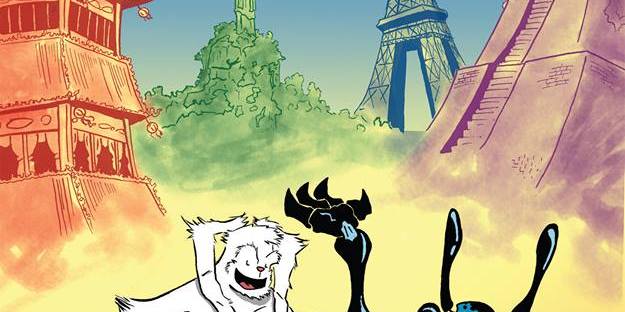

black, white & grey cover
Reviews

Review: Black, White & Grey

Hugo Boylan – the twisted mind behind Malevolence – sent me on a review copy of his new book with Rapha Lobosco, Black, White & Grey. As with all my reviews, I have a tendency to focus on the positive – especially true when I know the creator. Consider this a ‘Why you should buy this comic’ post (because I know this is one I’d love to have a physical copy of!)

Black Lines, Grey Morals

Hugo Boylan is, in my mind, a horror writer. The first book of his that I read was a horror, so the genre sticks in my head. This new book contains five stories: DreamweaverDay JobMurphy’s DayHeavy Black, and Black Neptune. It’s hard to tell which one disturbs me most. Conceptually, they’re all different. As stories, they’re paced differently, and rely on different scare tactics. The twists, the intrigues, the Big Bads, they vary between each story. And while it’s true to say that Boylan writes horror, and that each story contains elements of horror, there’s a greater depth of genre available in this book, when one looks at the stories separately.

Heavy Black is certainly closer to science fiction in terms of its content, while Murphy’s Day relies on the expectation of an incident to keep the reader guessing, set in an otherwise contemporary world. The final story in the book, Black Neptune, is extracted from a larger story, but contains enough of the tale to raise the question that a good story ought to: just what is going on?

To complement Boylan’s writing, Rapha Lobosco fills in the pages with – you might guess from the book’s title – a blend of black, white and grey artwork. Artistically, it can appear as a choice between colouring the art, or telling a story in black and white line-work. Conceptually, especially in a collection, the use of black, white and grey creates different atmospheres for the stories. Those told in black-and-white only are the stories that rely on twists and contrasts; what appear to be simple stories take sharp turns in the opposite direction.

When grey is introduced, we’re given two different uses of the colour; Heavy Black makes use of grey to emphasise the darkness of space (the story taking place on-board a craft in space), whereas Murphy’s Day uses grey as a means of dropping us in the middle of the story wondering where we might be taken – there is no clear-cut jump, only a wait for the shift in the story, something we have to drift through, like searching in murky water for a prized jewel. (Analogy spoiler alert: we find the jewel.)

Added to the stories are an original script – which is a nice addition from Boylan – for Dreamweaver, and concept art from Lobosco – always something I like to see at the end of a book. With a dark and dreary design pulled together by the book’s letterer, Kerrie Smith, we’ve given an impressive collection of stories from two of the finest up-and-coming comic creators in Ireland.

Black, White & Grey launches at Thought Bubble 2016 (that’s this coming weekend, folks). It’s a clever collection of intriguing stories, definitely one for fans of horror, and receives an all-round recommendation from me. You can check out Heavy Black on Taptastic in its entirety if you want a taste of what the collection is like.

Celtic Clan Cover
Reviews

Review: The Celtic Clan 1-3

Nigel Flood from Punt Press sent me The Celtic Clan 1-3 to review. Looking at this from a Road So Far point of view, I’ve combined the review of the series to this point into one post, taking a look at series overall, rather than on an issue-by-issue basis. As always, I aim for the most positive aspects of a book as much as possible in my reviews.

Another Irish Superhero Story?

For such a small country, our comic creators love to create large teams of Irish superheroes. Buttonpress have one. Cremona Press have one. And, though they also release other titles, Punt Press have one. There’s always a problem with scale when it comes to superhero stories – just how many characters should you attempt to fit into one story? – and I think for the most part, Flood and co. have the max figured out. The Celtic Clan featured in the book, if you ignore the additional ensemble of supporting heroes, is enough to make the difference on the panels, and allows for a few different stories to be told at once.

I should say, I preferred Flood’s other work – The Globalists – but there’s a lot of fun to be had in the pages of The Celtic Clan. It’s definitely a more jovial comic, not quite on the all-ages spectrum of Buttonpress comics, but with a lot of the humour that a more violent comic needs when the cast are wearing spandex.

Villainsssssss

When I initially read the comics, I thought the idea for the villains was a bit…silly? I’ll settle on silly. I even thought that when I was tired and made my notes for this very review. Several days later, and taking into account everything I’ve already said, I revise that statement.

The villains of the comics are snake people. Yes, snake people. Lizard people, maybe. But definitely reptilian in nature, with a fun throwback to one of the strangest conspiracy theories we still occasionally hear about – the underground lizard people who rule the world!

Flood takes advantage of this to cast an eye back into Irish history, and manages to create a greater sense of mythos within his comics than three issues should really allow. (Bravo on that!)

The books are fast-paced, and artist Frank J Right succeeds in driving the story along expertly, and fleshing out the details on a wholly bizarre set of characters, seemingly without issue.

(And, it should be said, the characters vary in so many different ways. There’s a cat-man, lizard-people, a pixie-esque-woman, a classic warrior, a barbarian-ish old man, a speedster in spandex, and a monster made from whatever the ground can provide, be it turf, concrete or street poles. Despite the massive mix, he manages not to deviate from his style, and depicts everything skilfully.)

All in all, The Celtic Clan is a fun series. It’s worth checking out if you like superhero comics and want to support small press. How long we’ll have to wait for issue 4, however, remains to be seen.

Malevolence Cover
Reviews

Review: Malevolence

Launched at Dublin Comic Con, and then again in a library in Clonmel (because libraries are cool, and that’s where the artist lives), Malevolence is a new horror comic from writer Hugo Boylan and artist John Quigley, with Dearbhla Kelly on Colours and Kerrie Smith on Letters. John asked me, before I met him at DCC and talked the ear off him (and attempted in vain not to be sold almost everything from his table), if I would review Malevolence. As usual, don’t take the review too critically – I know I won’t while writing it!

Twisted

One word sums up the book. Twisted. From Boylan’s writing, to Quigley art, Kelly’s colours, and even Smith’s lettering. The individual elements of this comic twist together to make something uniquely engaging. I wouldn’t want to spoil the plot for you, but the basics you need to know about Malevolence are these simple facts:

1. The comic takes place across three decades.

2. The comic is filled with fleeting moments of madness.

3. The comic wouldn’t make much sense without Kelly and Smith’s contributions.

Colourful Dread

Most comics can get along with a strong story and a skilled artist. Black & White is an acceptable standard for storytelling. But colour brings this one to life. Colour is the only way we know when we are within the story. Colour invites us through three decades of horror. Without colour, an element so vital to this book, everything else would need to change. The book would need to be re-panelled, re-organised, maybe even re-written to a more linear story. But linear is common. Colour allows for Boylan and co. to create their non-linear nightmare.

Colour is the vital piece of dread that the books need to truly come alive.

When Smith’s lettering gets taken into account, the genre of the book is really played up expertly. There’s a lesson to be learned from letterers all-over about how to turn a writer’s words into part of the art itself within Malevolence.

The book builds upon a beautifully horrid concept and executes it in terrifying fashion.

You can get your hands on Malevolence – and you really should – from Hugo Boylan and John Quigley directly. Hugo can be found at @HugoBoylan; John can be found at @johnquigley209.


The Globalists
Reviews

Review: The Globalists #1

Nigel Flood of Punt Press got in touch with me lately to see about reviews of a few of his books – and he was quick to send on issue #1 of The Globalists, and issues 1-3 of Celtic Clan in the mail. So, full-disclosure for this review, they were free review copies. Reminder, also, that when it comes to comics, I’m not overly critical; I love to explore the reasons I think people will enjoy a particular comic (which helps in recommending the books people would enjoy!) With that said, onto the review.

Not Your Average Superhero Comic

The first thing that will be apparent from the cover of the book: it’s a superhero book. It looks every bit the genre; Kevin Keane certainly knows how to draw for the market. The characters – and we’ll get onto them in a minute – are fully brought to life in a way that’s typically expected of the Big Two. Before readers get into Nigel Flood’s tale, there’s an instant feeling of familiarity that helps ease newbies to the writer’s work into the book.

And what a book.

Intriguing from the very start, The Globalists presents us with an unknown narrator in a prison cell, a glimpse at the snarling face of one Adolf Hitler, and a concise expository history lesson on the Superhuman Arms Race. From there, it’s all downhill. And uphill. It depends on your perspective.

As a first issue, the book manages to fit in a lot. We’re given a measure of the powers at play (pun 100% intended), the backstory to the issues at hand in the modern day, a glimpse at the protagonists, and a sense of the scale of danger presented by the antagonists. I’m a sucker for superhero stories. I devour them greedily. And I need more of this from Flood and co.

While some stories start a little unsure of themselves, Flood gives us an established dilemma and philosophy, to be explored in greater detail as the series continues. All we need now is a release date for the next issue. In the meantime, you can get a copy of the series debut from Punt Press directly, or in Forbidden Planet Dublin, while stocks last. Recommended for fans of superhero comics looking for a fresh take on the genre.

Rabbit and Paul Cover
Reviews

Review: Rabbit and Paul

Over the past few years, there’s been an explosion of Irish comics. Last year, the most Irish comic ever was published by Offaly-native Seán Hogan: Rabbit and Paul.

Set in the small town of Bally’O’Jhaysus (+2 Irish-ism Points), the book follows the tale of Paul and his anthropomorphic rabbit-friend, Rabbit. Rabbit is acquired in a Tat Shop (+1 Point), despite warnings from Paul’s parents about not bringing any more tat into the house. (+1 Point) Through a bizarre series of events involving a strange, illegal candy (+1 Point for vague drug dealer reference), a fascination with a particularly large Chinese restaurant (+1 Point), and a range of hilarious Irish phrases (1+ per use… I think you get the idea: extremely Irish book), the journey of the titular duo is mapped out in bizarre fashion.

This is a unique celebration of the peculiarity of Irishness, capturing Irish humour in its purest (and most PC) form in its smallest details. Anybody with a notion of experience with Ireland will immediately understand the references made throughout the book, though it should be said that the Irish audience will benefit most from the tiniest jokes hidden in the pages.

Rabbit and Paul is a charming, witty book, enough to keep readers laughing long after the last page. Barely after finishing it did I feel an obligation to get my hands on a second copy as a gift for a friend. Anyone who can get past the anthropomorphic line in the blurb is sure to love the story, told with a great capacity for what it means to be Irish.

Hogan has produced an impressive debut, both in its writing and its illustrations. The comic will leave readers wanting more. For the moment, a conversation with the book’s creator will have to suffice. You can catch him, and Rabbit and Paul, at Dublin Comic Con.

Brain Fetish Cover
Reviews

Review: Brain Fetish

I picked up Brain Fetish by Kinga Korska under the proviso that it had something to do with brains, boobs, or both, a classic case of judging a book by its cover. In a way, I wasn’t wrong.

Kinga Korska, a Polish writer and artist living in Dublin, has given us a remarkably candid book on relationships, philosophy, and psychology. Even without addressing the story, we already have a quick-read textbook on how to have better relationships in your life, through careful examination of how we communicate, and why people say certain things. It’s an incredibly wise book, proving Korska’s wealth of wisdom well beyond her years. But it’s more than a textbook. This is a novel, filled with love and humour and the incredible intricacies of human relationships.

I first met Kinga at the inaugural Geek Mart in Dublin, shortly after I got my hands on her book. She arrived with a table’s worth of books and magnets, dressed in full cosplay despite the heat. Memory recalls that she was a steampunk Alice Madness. She was witty and charming, and she sold her book well to prospective customers through sheet force of character. Understanding Kinga is a good way to understand her book; both come equipped with refreshing honesty and a wicked sense of humour.

Even in dealing with such a complicated theme – people are the most complicated thing that most of us will encounter in our lives, pending alien invasion or supernatural apocalypse – and through a complex style, with a detailed, continuous narrative, Korska makes the subject matter easy to understand. In a manner of contradictions, Korska paints this difficult story and teaches a powerful message all through the use of black-and-white artwork; rarely grey-scale, simplistic (albeit consistent) in style, and whole capable of illustrating a point. Few artists can embrace simplicity the way Korska does while simultaneously addressing an incredibly deep narrative.

This is a raw book, and may leave some readers feeling uncomfortable with how they once thought about others, but it represents an important aspect of comics and their power to shape the world and those of us lucky enough to share it at this moment in time.